Home / All Trades / Solar Installer
Career Profile · Trades

Solar
Installer

Salary · Training · Career Path · 2024 Data
$51,860
Median annual salary
BLS · 2024
28K
Job growth 2024–2034
BLS — fastest growing
10%
Jobs nationwide (growing)
BLS · 2024
6 mo
Certificate program
Trade school path
$80K+
Top earner ceiling
BLS top 10%
Programs near you have limited open seats
Start Your Solar Career
Free · No commitment · Match with programs near you
You are in.
We will match you with programs near you. Check your email within 1 business day.
Salary data

What Solar Installers Actually Earn

Median annual salary
$51,860
Among the fastest-growing trades nationally
Top 10% annual salary
$80,150+
Commercial solar and project supervisors
Entry level
$39,070
First-year installer helper wage
Job growth rate
$24.93
BLS 2024–2034 — fastest growing trade
Entry-level solar installer
$39,070
Median solar installer
$51,860
Commercial solar specialist
$80,150
Avg 4-yr degree salary
$65,677
Solar installation is the fastest-growing trade in the BLS database at 24% projected growth through 2034. Federal IRA incentives have created sustained demand that extends well beyond residential rooftop installation into utility-scale and commercial projects.

Sources: BLS OES May 2024 · SOC 47-2231. Individual results vary by market, certification, and project type.

Florida median salary
$44,000
Fast-growing market with strong sunshine hours
Florida top 10%
$65,000+
Commercial and HOA community solar specialists
Entry level in Florida
$31,000
First-year installer — FL wage level
FL sun advantage
Top 3
Florida is a top 3 solar market for sunlight hours
Tampa area solar
~$44,000
Orlando area solar
~$43,000
Miami area solar
~$46,000
Florida-specific: Florida is a top-3 US solar market by installed capacity and growth trajectory. Federal IRA incentives combined with high electricity costs and excellent sun hours are driving residential and commercial installation demand. Electrician licensing is required for the electrical work portion of solar installations in Florida.

Sources: BLS OES May 2023 FL state data · CareerOneStop. City estimates based on BLS metro data.

California median salary
$56,000
Largest solar market in the US
California top 10%
$85,000+
Commercial and utility-scale supervisors
Entry level in California
$38,000
First-year installer — CA wage level
CA market driver
Mandate
CA requires solar on all new residential construction
Los Angeles area solar
~$58,000
San Diego area solar
~$56,000
Bay Area solar
~$63,000
California-specific: California is by far the largest solar market in the country and requires solar on all new residential construction. The state mandate, high electricity costs, and federal incentives create sustained installation demand. NABCEP certification is increasingly expected by California commercial solar employers.

Sources: BLS OES May 2023 CA state data · CareerOneStop. City estimates based on BLS metro data.

Training paths

How to Become a Solar Installer

Three ways in.
  • Solar PV installation certificate 6 months. Fastest entry into employment of any trade we cover.
  • Electrician + solar specialization Longer path, broader electrical foundation, higher commercial earning ceiling.
  • On-the-job training Many solar companies hire helpers and train on-site. Lower entry cost, slower advancement without certification.
See the full solar installer training requirements
Your trade-school advantage
Ready to see your $187K path?
See programs near you that get you there.
See programs near you
Day in the life What the Job Actually Looks Like
+
Day in the life

What the Job Actually Looks Like

6:30 AM
Team assembly and load-out
Meet at the company yard, load panels, racking, inverters, and tools into the truck. Review the day's installation plans and safety briefing.
7:30 AM
Site arrival and roof assessment
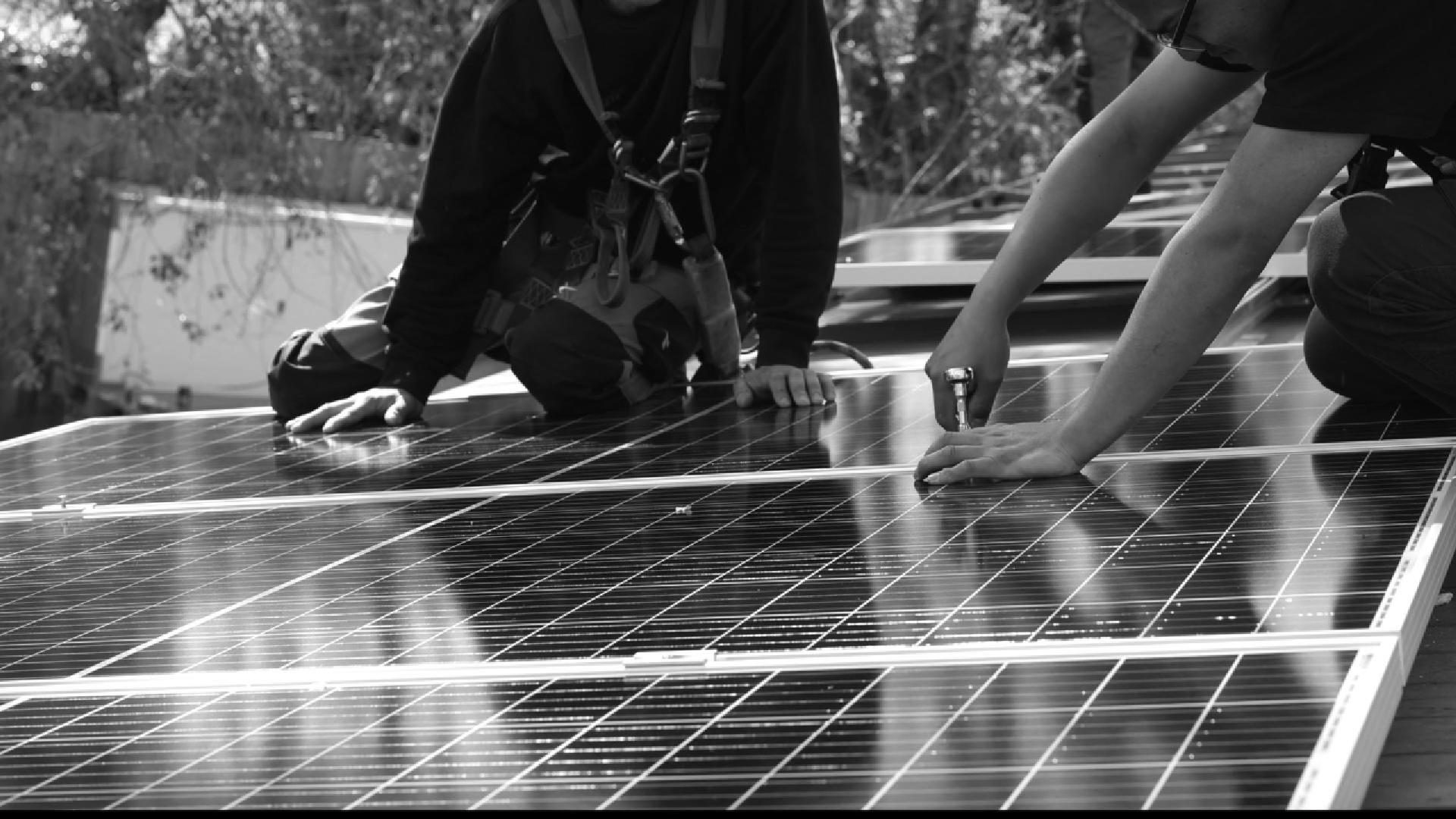
Assess the roof condition, locate rafters and attachment points, set up safety equipment. Safety on the roof is job one — always.
8:00 AM
Racking installation
Drill and mount the racking system to the roof structure. Precision matters — the racking alignment determines how the panels sit for the next 25 years.
10:00 AM
Panel installation
Lift and mount panels to the racking system, connect mechanical attachments. A standard residential system might have 20–40 panels to mount.
1:00 PM
Electrical wiring and inverter
Run conduit, pull wire, connect panels in series or parallel strings, install and wire the inverter. A licensed electrician handles the service panel connection.
3:30 PM
System test and cleanup
Power up the system, verify production on the monitoring app, complete the inspection checklist. Clean up the site and load equipment for tomorrow.
What you will need Skills That Make a Great Solar Installer
+
What you will need

Skills That Make a Great Solar Installer

Comfort with heights
Most residential solar work is on rooftops. You need to be comfortable working at height with proper fall protection equipment, in all weather conditions.
Electrical fundamentals
Understanding DC circuits, series and parallel wiring, and inverter operation. The electrical portion of solar installation is where NABCEP certification matters most.
Physical conditioning
Carrying 50-pound panels up ladders, working in direct sun, drilling into roof structures. Solar installation is physically demanding work.
Precision installation
Racking alignment, panel spacing, and weatherproof penetrations all have to be right. A leak at a roof penetration undermines the whole system.
Safety discipline
Fall protection, electrical safety, and tool discipline are non-negotiable on solar job sites. OSHA 10 is the baseline standard — most employers require it.
Customer interaction
Residential solar crews work directly at homeowners' properties. Professional conduct, site cleanliness, and clear communication affect reviews and referrals.
Job market outlook The Market for Solar Installers in 2026
+
Job market outlook

The Market for Solar Installers in 2026

Projected job growth 2024–2034
10%
BLS — fastest growing trade occupation
IRA incentive driver
30%
Federal tax credit through at least 2032
Current solar installer jobs
28K
BLS · 2024 — rapid growth from smaller base
AI displacement risk
None
Rooftop installation cannot be automated

Solar installation is the fastest-growing occupation in the BLS database. Federal IRA incentives have created a 30% tax credit for residential and commercial solar that extends through at least 2032 — providing a multi-year runway of subsidized demand driving hiring across the industry.

Utility-scale solar — large ground-mount projects in the Southwest, Southeast, and Midwest — is creating demand for installers who want to work on projects rather than residential rooftops. These projects pay better and offer more consistent year-round employment.

The intersection of solar with battery storage is the next frontier. Installers who develop expertise in battery storage systems — Tesla Powerwall, Enphase, SunPower — will command premium rates as storage adoption accelerates alongside solar.

Common questions Solar Installer FAQs
+
Common questions

Solar Installer FAQs

Solar PV installation is the fastest-growing occupation in the BLS database at 24% projected growth through 2034. This is driven by the Inflation Reduction Act's 30% federal tax credit, falling panel costs, and rising electricity prices making solar economics compelling for homeowners and businesses.
NABCEP (North American Board of Certified Energy Practitioners) is the leading solar industry certification. The NABCEP Entry Level Certificate is the starting credential. The NABCEP PV Installation Professional (PVIP) is the advanced credential recognized by commercial and utility-scale employers.
Depends on the scope. The mechanical installation of panels and racking generally doesn't require an electrician license. However, the electrical work — connecting to the service panel, pulling permits — requires a licensed electrician in most states.
In southern states like Florida, California, Texas, and Arizona, solar installation is year-round. In northern states, installation slows in winter months. This is one reason why FL, CA, TX, and AZ dominate solar employment.
Yes — and commercial is where the better pay is. Commercial solar projects are larger, longer in duration, and pay higher wages. NABCEP PVIP certification and experience with utility-scale inverters and racking systems are the keys to making the transition.
Earn more

Similar Trades That Pay More

What people are saying
The salary data on this site is more detailed than anything I found elsewhere.
AdamGeorgia
I sent this to my nephew who’s considering trades — incredibly thorough.
TonyFlorida
Finally a site that gives real numbers without trying to sell you something.
MattPennsylvania
Your Solar Career
Starts Here.

We will match you with solar installation programs near you. Free for workers. Always.

Take the Career Quiz → Browse All Trades
START YOUR TRADE CAREER FREE MATCHING · 2 MIN · NO SPAM
Get Matched Free →